

Monite API changelog
October 2, 2025
Accounts receivable
- Text search across multiple fields. New
search_textparameter lets you perform partial, case-insensitive search across multiple text fields in receivables. Currently it searches in counterpart names and document numbers (document_id). Thesearch_textparameter is available in:
September 24, 2025
Accounts receivable
-
Improved support for non-taxable and tax-exempt sales. Line items in receivables have the new
tax_statusfield that indicates whether this item is taxable (default), non-taxable, or exempt from VAT/tax. Non-taxable and exempt items are excluded from the tax summary in the totals of the line items table in PDFs. -
Attachments can now be added and updated for receivables in any status.
September 23, 2025
Accounts payable
- Approval policies. Added support for manually enforcing an approval policy on a payable via the new field
enforce_approval_policy_idin create and update requests. The enforced policy is always applied, ignoring triggers and priority. - E-invoicing. Added the field
einvoice_file_urlto payables. When a payable is created from an e-invoice, the original file is stored and its download link is returned in this field.
September 22, 2025
Accounts receivable
-
Support for multiple deductions. Invoices and quotes can now have up to 10 deductions applied to the total amount after VAT. Use the new
deductionsfield to specify a list of deduction amounts and their labels.The old
deduction_amountanddeduction_memofields are still supported but have been deprecated and made mutually exclusive with the newdeductionsarray. -
Finding invoices with or without a due date. Receivable search endpoints have a new boolean filter
has_due_datethat lets you find invoices that have a due date (regardless or its value) or do not have a due date. This filter is available in:
September 12, 2025
Accounts receivable
-
Invoice due date and payment terms are now optional. Note that invoices without a due date do not generate payment reminders.
-
Improved the performance of receivable creation and search endpoints:
POST /receivablesGET /receivablesPOST /receivables/search
-
As part of the performance improvements, the
created_at__*andissue_date__*filters inGET /receivablesandPOST /receivables/searchnow ignore the milliseconds part of their value. For example:created_at__gte=YYYY-MM-DDThh:mm:ss.sssssZwill be treated as
created_at__gte=YYYY-MM-DDThh:mm:ssZ
September 11, 2025
Accounting integration
- Added full CRUD APIs for general ledgers, tax rates, and cost centers. The
is_externalfield is the indicator for external integrations.
Expense management
- We enhanced expense management by linking expenses directly to accounting structures. Receipts and line items now support
ledger_account_id,tax_rate_id, andcost_center_id.
September 10, 2025
- Added the
GET /healthendpoint for API health checks.
September 1, 2025
Expense management
-
We’ve introduced expense management as a core Monite capability, enabling businesses to handle the full lifecycle of company expenses in one place, connecting receipts and transactions. Some of expense management features include:
- AI-based receipt-to-transaction automatching. AI-powered matching that links receipts to transactions after OCR, based on the date, amount, and merchant name (exact or semantic match).
- AI-generated expense descriptions post-OCR, automatically filling the
descriptionfield with concise, business-relevant text.
-
Added new RBAC permissions:
receiptandtransaction. They are required to call the/receiptsand/transactionsendpoints using an entity user token. -
Added webhooks for receipts and transactions:
receipt.createdreceipt.updatedreceipt.deletedreceipt.ocr_finishedtransaction.createdtransaction.updatedtransaction.deleted
Other improvements
- Filtering tags by category. We’ve added new optional query parameters
categoryandcategory__into theGET /tagsendpoint. - Improved analytics for payables. We’ve added support for
amount_dueas ametricin theGET /analytics/payablesendpoint. - The request body for
POST /payment_recordsand/{payment_record_id} /start_processing POST /payment_recordsis now optional. Previously, if you wanted to provide no/{payment_record_id} /cancel payment_intent_statusfor these actions you still had to send an empty object{}in the request body. Now you can omit the request body in this case.
August 28, 2025
Accounts receivable
-
Improved the performance of
GET /receivablesandPOST /receivables/searchwhen searching byproduct_id. -
Previously, a custom
document_id(document number) could be specified only during document creation. Now you can also update it for existing invoices and quotes in the non-compliant mode by usingPATCH /receivables/{receivable_id}.
August 21, 2025
Accounts receivable
We’ve added several improvements for email sending:
- Added entity setting
mail.reply_toto specify a list of email addresses to be used as the “Reply to” addresses in outgoing emails, such as invoice emails and payment reminders. - Added new variables for email templates:
{currency_symbol}{footer}{memo}
- Partner metadata defined in invoices, quotes, and credit notes can be included in emails by using the
{partner_metadata.<key>}variables. For more information, see Using metadata in emails.
August 13, 2025
Accounts receivable
- Increased the maximum number of
componentsin custom VAT rates from 3 to 10. - Added the
is_einvoicefield to credit note responses to indicate whether the credit note will be sent via e-invoicing. Credit notes inherit theis_einvoicevalue from the original invoice.
August 12, 2025
- Entites that do not use Monite payment rails can add USD bank accounts regardless of the bank account country.
- The
payment_intent_idfield is no longer required when creating payment records with thecreatedstatus. It is still required for payment records in theprocessingandsucceededstatuses.
July 29, 2025
Accounts payable
- Added the
routing_numberfield to thecounterpart.bank_accountobject in the payable payload.
July 17, 2025
Accounts payable
-
AI-powered counterpart suggestions. Now, when a user uploads a payable, Monite automatically analyzes the payable data and uses AI to suggest the most likely matching counterpart. The suggestion can be checked by calling
GET /payables./{payable_id} /suggestions -
Added the ability to transition payables from
waiting_to_be_paidback tonewstatus by callingPOST /payables. The rollback is supported for payables both with and without approval flows./{payable_id} /reopen -
Added support for editing the
amount_paidfield via thePATCHmethod for payables in thenewanddraftstatuses. -
The deprecated partner setting
payable.enable_line_itemshas been un-deprecated.
Accounts receivable
-
Attaching files to receivables. Invoices, quotes, and credit notes have a new
attachmentsfield that you can use to attach supplemental documents like contracts or reports. Monite also gives you granular control over which attachments get emailed or just stored for reference. For more information, see Invoice attachments. -
Customizing the line items table in PDFs. We’ve added new options to control the appearance of the line items table in PDF invoices, quotes, and credit notes. You can now hide individual columns or the entire line items table, change column labels, and change the precision of numeric fields (such as prices and VAT rates) to match industry norms and client expectations.
This feature is currently supported only for the new PDF template
default_monite.The new options are available as part of the entity setting
document_rendering:display_line_items(boolean) - controls whether to show or hide the entire line items table,line_items(object) - controls the visibility and appearance of individual columns in the line items table.
Example
Entity settingsGlobal
document_renderingsettings can also be overridden in individual invoices, quotes, and credit notes. Invoices created from quotes and credit notes created from invoices inherit thedocument_renderingsettings of the original document. -
Estonian standard VAT rate has been updated from 22% to 24% to reflect the recent changes in VAT.
Other improvements
We’ve made some changes to the /files API:
- Added a new
file_typeenum value:attachments. - Changes in
GET /filesquery parameters:- Added a new optional query parameter
file_typeto filter the uploaded files by purpose. - The
id__inquery parameter inGET /fileswas changed from required to optional. - Either the
id__inorfile_typequery parameter is required to callGET /files.
- Added a new optional query parameter
July 7, 2025
E-invoicing improvements
- Added a new endpoint
GET /einvoice_searchto check if a specific VAT number or business number is registered in the PEPPOL network. You can use it to look up an entity’s counterparts in PEPPOL before creating e-invoices.
July 4, 2025
Partial payment links for accounts receivable invoices
Payment links for accounts receivable invoices can now be created for a partial invoice amount. Entities can use this to request down payments from counterparts, or to let counterparts pay for large purchases in several installments.
Partial payments and credits reflected in PDF invoices
Entity setting generate_paid_invoice_pdf now applies not only to fully paid invoices, but also to partially paid invoices and invoices with credit notes.
If this option is enabled, the totals block in the PDF invoice will include a list of all payments made and credit notes issued.
For example:
Other improvements
-
When using Monite payment rails, a payment record is now created right after a payment intent is created (for example, whenever a user creates a payment link). Previously, payment records were created only for
succeededpayment intents.The status of those payment records will be automatically updated to reflect the status of the associated payment intents.
July 1, 2025
Approval policy improvements
- Added an optional
priorityfield to control which policy applies when multiple match. Higher values are evaluated first.
June 26, 2025
-
Added a new endpoint that returns the next sequence number for invoices, quotes, credit notes, delivery notes, and purchase orders:
GET /entities/{entity_id} /settings /next_document_numbers For example, if the last issued invoice has the document number
INV-00042, this endpoint returns 43 as the next invoice number. You can use these numbers as minimums when setting the next document numbers manually.
June 23, 2025
Accounts receivable
-
Custom footer text. Invoices, quotes, and credit notes have a new optional
footerfield. It is similar tomemobut displayed below the line items table in the PDF.The footer is included only in the new PDF template
default_monite(mentioned below) and is not displayed in other PDF templates. -
Project name in PDFs. Invoices, quotes, and credit notes now display the name of the associated project in the PDF document header. This improvement applies to all PDF templates.
-
New PDF template
default_moniteis available for invoices, quotes, and credit notes - in addition to the existing templates. This template features a clean and modern design with a focus on simplicity. It’s the first of many new templates coming to the Monite platform in the following months.We recommend that partners set this PDF template as default for new entities, and later migrate existing entities from the old PDF templates to the new ones. Old PDF templates (
classic,standard, and others) will eventually be deprecated in favor of the new templates.How to set the new PDF template as default
The template ID
deb7a4d1-e46c-4e01-8189-d5f249da7a2fis the same in all environments.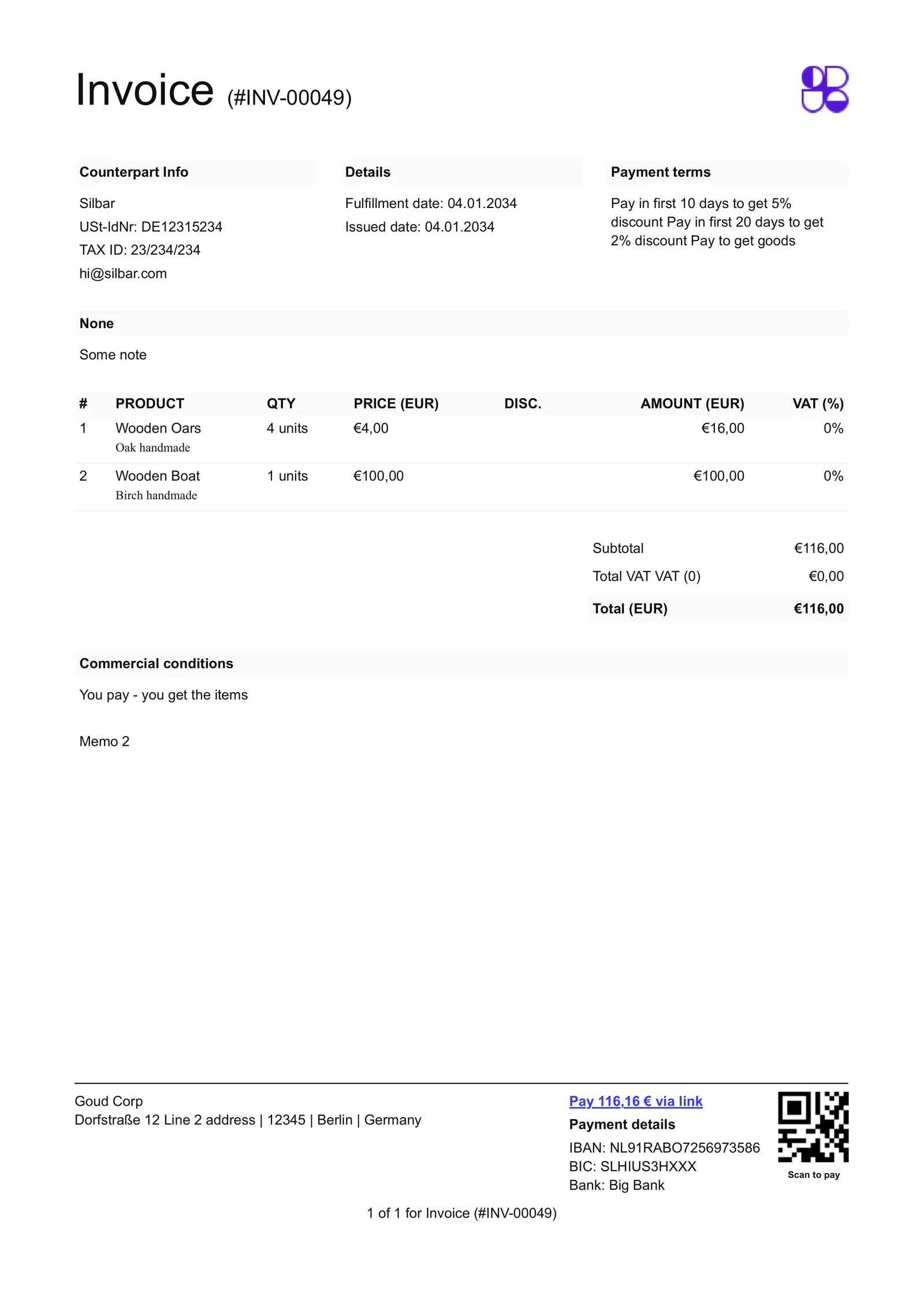
New PDF template
June 18, 2025
PATCH /entities/{entity_id}/settingsendpoint can now be accessed with entity user tokens. The user must have a role with theentity.updatepermission.
June 16, 2025
Entity improvements
PUT /entities/{entity_id}/logoandDELETE /entities/{entity_id}/logoendpoints can now be accessed with entity user tokens. The user must have a role with theentity.updatepermission.
Accounts receivable
- Products have a new field
external_referencethat lets you map products between Monite and external systems. This field is also available in inline products that are defined directly in invoices and quotes.
June 9, 2025
Buy Now Pay Later (BNPL) in the US with Klarna and Affirm
Klarna and Affirm are now available as payment methods in the Payment Web Component and payment pages. These BNPL payment methods can help entities enhance their cash flow by letting customers pay in installments while the entity receives the full payment upfront.
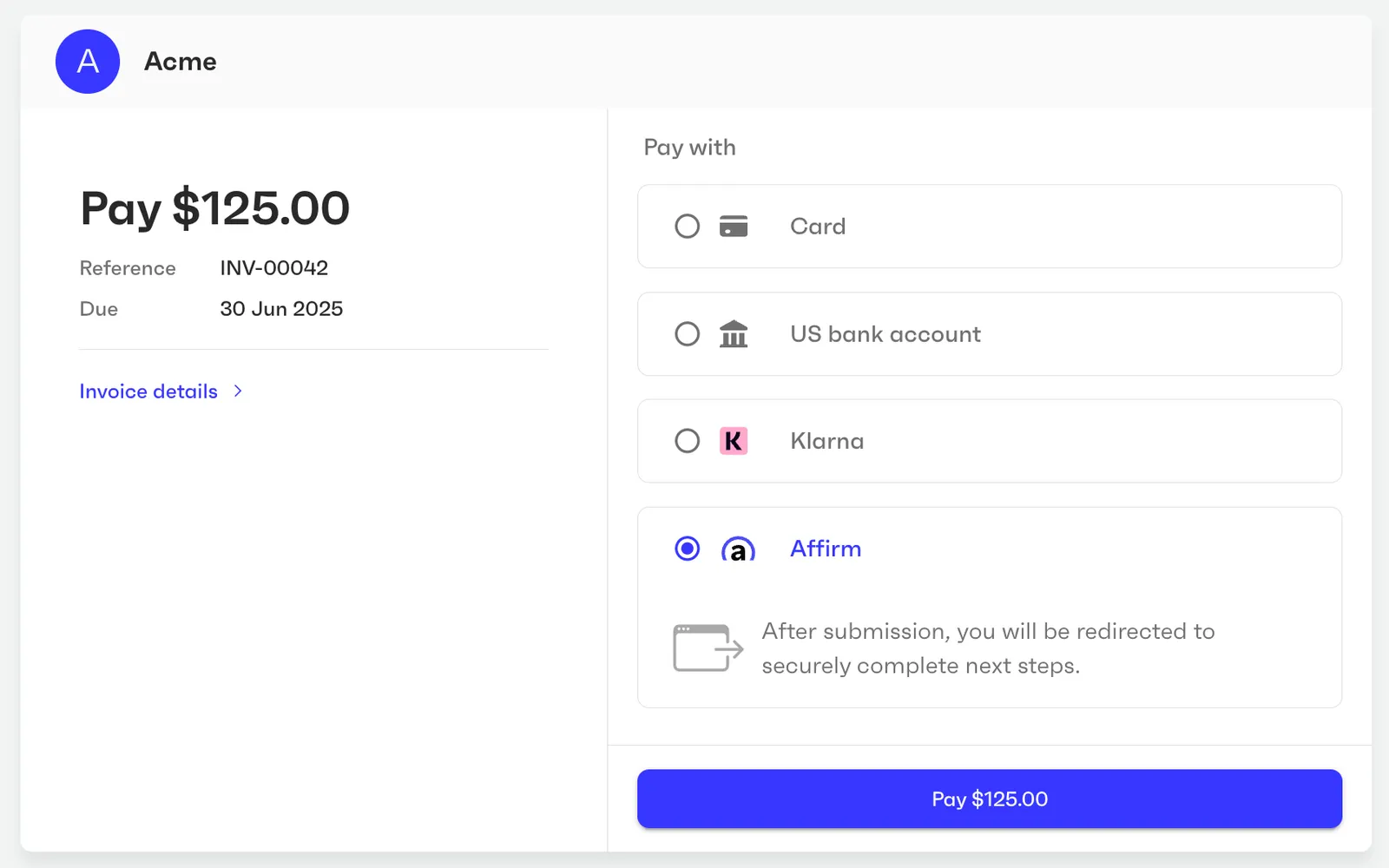
How to enable Klarna and Affirm
To enable Klarna and Affirm for your US entities, add them to the entity’s list of payment methods
and then include these methods when creating invoice payment links.
Open Banking for Austria BETA
We’ve expanded our payment coverage to include Open Banking payments in Austria. Payment links created for Austrian payers can now include a bank transfer payment option.
This also expands the available payment options for accounts payable and accounts receivable:
- Austrian entities can use payment links to pay payables (bills).
- EU and UK entities can receive invoice payments from their Austrian counterparts via bank transfers.
June 3, 2025
Canadian tax rates
Monite’s built-in catalog of VAT & tax rates now includes Canadian sales tax rates – GST, PST, QST, and HST. This gives Canadian entities an option to select invoice tax rates from the catalog instead of filling in the values manually.
Composite tax rates indicate their components, for example, GST 5% + PST 7%.
Example of tax rate data for Canada
Accounting integration improvements
- When invoices and products are pushed into an accounting system, if a product’s description is empty it is set to the product name. This is to comply with accounting system requirements which expect a non-empty description for invoice line items.
POST /accounting_synced_recordsnow supports force-pushing of payment records./{synced_record_id} /push - Improved the error message when a payment record could not be pushed because the related invoice or invoice counterpart are not pushed yet or were pushed with errors.
These errors are included in results from
GET /accounting_synced_records.?object_type=payment_record
May 30, 2025
Accounts payable
- Payment records history. Now, the
GET /payment_recordsandGET /payment_records/{payment_record_id}endpoints have a new fieldhistory, that provides a chronological log of all status changes for a payment record, helping track its full lifecycle.
May 28, 2025
Accounts payable
-
Payables history. You can now retrieve document history for payables using the new
GET /payables/{payable_id}/historyendpoint. The history tracks key events such as when a payable is created, updated, or deleted; when its status changes; and when a credit note is linked or unlinked. -
Improved filtering by tags. We’ve added an optional query parameter
has_tags(trueorfalse) toGET /payablesandGET /analytics/payables. You can use this parameter to filter payables based on whether they have tags.
May 27, 2025
Accounts receivable
-
Philippines support. We’ve added VAT rates and regulatory coverage for the Philippines. Refer to the additional considerations for invoicing in the Philippines.
-
Invoice due date can now be set directly instead of calculated based on payment terms. To set the due date, use the
payment_terms.term_final.end_datefield when creating or updating an invoice.Example
POST /receivables -
Invoice payment terms can now be defined inline, as an alternative to referencing a pre-existing payment terms object. The due date and early discount dates can be defined with either
number_of_daysorend_date; the other field will be calculated automatically.Example
POST /receivables -
When using
tax_rate_valueto specify invoice VAT rates inline, you can now also specify thetax_rate_namelabel to use in PDF invoices.Example
POST /receivables
May 16, 2025
Accounting integration improvements
- Existing counterparts are now pushed into accounting systems whenever invoices addressed to those counterparts are pushed. This helps ensure that counterparts created in Monite before creating the accounting connection are synchronized properly.
- Improved logging to indicate when products could not get pulled from accounting systems because of a negative price or no price. These errors are included in results from
GET /accounting_synced_records.?object_type=product
May 15, 2025
Accounts receivable
We’ve improved how custom VAT rates are displayed in PDF invoices, quotes, and credit notes. The totals section in PDFs now includes a breakdown of VAT amounts per VAT component. For example:
May 13, 2025
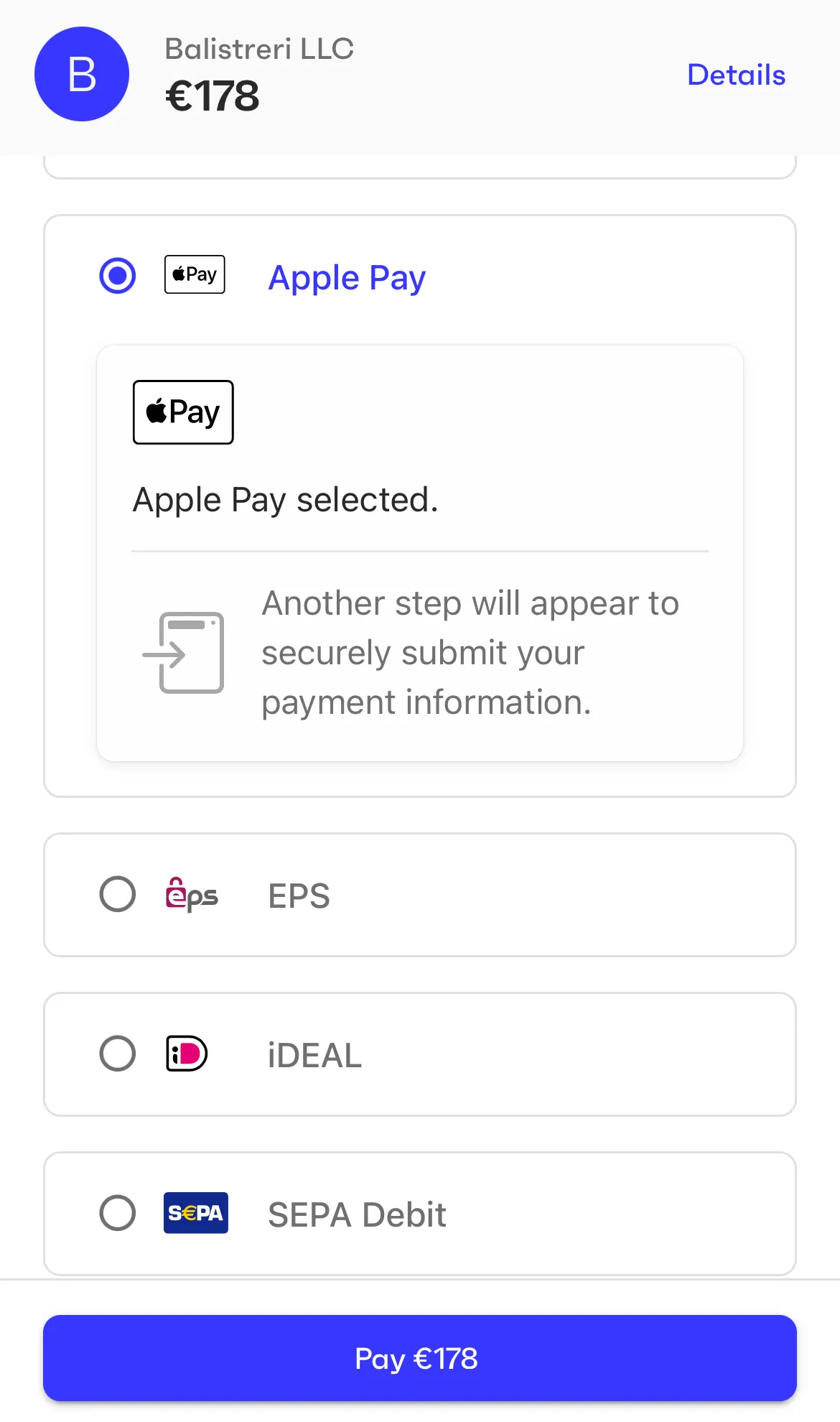
Apple Pay and Google Pay support
Apple Pay and Google Pay are now available as payment methods in the Payment Web Component and payment pages. These payment methods are available by default to all entities that are onboarded to receive card payments.
Apple Pay and Google Pay options are displayed to payers with compatible Apple Pay devices and Google Pay devices if the payer’s wallet has at least one card.
Partners who use a custom domain for payment pages should contact their Monite Account Manager to enable Apple Pay and Google Pay for their entities.
Accounts receivable
This release improves the search functionality for receivables:
-
Added the
POST /receivables/searchendpoint as an alternative toGET /receivables. The POST version works the same as GET but sends the search and filter parameters in the request body instead of the URL query string. You can use the POST version for complex search queries where using GET would exceed the URL length limit. -
Significantly reduced the length of the pagination tokens returned by
GET /receivablesandPOST /receivables/searchto reduce the overall request size for paginated requests. -
Pagination tokens used by
GET /receivablesandPOST /receivables/searchnow expire after 24 hours. These pagination tokens are intended to be used immediately after you receive them and not stored and used at a later time.
The changes in pagination tokens apply only to the GET /receivables and POST /receivables/search endpoints and do not affect other Monite API endpoints.
Other improvements
- Added new
object_id__inquery parameter toGET /payment_recordsto get payment records for multiple payables and/or receivables at once.
May 12, 2025
This release brings many new features and improvements to Monite Accounts Receivable APIs, including changes in recurring invoices, VAT rates, new regulatory compliance areas, and more.
Recurring invoice updates
Several quality-of-life enhancements have been added to recurring invoices. These changes are fully backward compatible and involve only the addition of new fields to the existing API:
- Flexible scheduling options: Recurring invoices can now be configured to recur daily, weekly, monthly, quarterly, or yearly. You can also specify the exact day of the month or day of the week for invoice generation. Previously, the API supported only monthly recurrence on the first or last day of the month.
- Pause and resume support: Recurring invoices can now be paused and resumed as needed, without requiring deletion or recreation.
- Editable invoice templates: The base invoice template can be updated to add or remove line items, adjust pricing, and modify other invoice details. These updates will automatically apply to future invoices generated from the template.
Detailed list of changes and migration notes
All changes are non-breaking and are backward compatible. The changes are available in all supported API versions: 2024-05-25, 2024-01-31, and 2023-09-01.
You can continue using the old recurrence configuration format for as long as you need. There is no immediate need to update your code.
-
Added new endpoints to pause and resume recurrences:
-
Improved:
PATCH /receivables/{receivable_id}now supports updating invoices in therecurringstatus (that is, the invoice templates for recurring invoices). -
Improved: The
receivable.failedwebhook is now also triggered when a recurring invoice cannot be issued due to validation or regulatory errors.- Applies to recurrences with
automation_levelset toissueorissue_and_send.
- Applies to recurrences with
-
Updated the
Recurrenceobject format (used by the/recurrences*endpoints):-
Added new fields for schedule configuration:
start_date,end_date,max_occurrences,frequency,interval.- These new fields are optional for backward compatibility.
-
Deprecated the old configration fields:
start_month,start_year,end_month,end_year,day_of_month.- These fields are still accepted and returned by the API, but they will be removed in a future API version.
- These deprecated fields were also changed from required to optional and made nullable.
Example
New format
Old (but still supported) format
-
Existing recurrences will continue working and were automatically updated to also support the new configuration fields.
-
For backward compatibility, the API accepts and returns both old and new fields and automatically synchronizes their values where possible.
Caveats:
- Recurrences that trigger on any day of month other than the first day will return
day_of_month="last_day". - Recurrences configured with
max_occurrencesreturnend_year=nullandend_month=null.
- Recurrences that trigger on any day of month other than the first day will return
-
When creating or updating a recurrence, if the request includes both old and new fields then the new fields take precedence and the old fields get overwritten with the values of the corresponding new fields.
-
Added new possible recurrence status values:
statuscan have the valuepaused(in addition to the previous valuesactive,completed, andcanceled).iterations[].statuscan have the valueskipped(in addition to the previous valuespending,completed,issue_failed,send_failed,canceled).
-
Custom VAT rates
-
Added new endpoints for managing custom VAT rates:
POST /custom_vat_rates– create a new custom VAT rate.GET /custom_vat_rates– get all custom VAT rates.GET /custom_vat_rates/{custom_vat_rate_id}– get a specific custom VAT rate by ID.PATCH /custom_vat_rates/{custom_vat_rate_id}– update an existing custom VAT rate.DELETE /custom_vat_rates/{custom_vat_rate_id}– delete a specific custom VAT rate.
-
Added new
custom_vat_rate_idfield in the following endpoints:POST /receivables– create a new receivable with custom VAT rate.PATCH /receivables/{receivable_id}– update an existing receivable with a custom VAT rate.
-
Added the
is_customfield to theTotalVatAmountItemandLineItemProductVatRateobjects to indicate whether the VAT rate is custom.
Other accounts receivable improvements
-
New Zealand support. We’ve added GST rates and regulatory coverage for New Zealand.
-
GET /receivablesnow supports sorting and filtering results bydiscounted_subtotal(the subtotal amount incuding all discounts but excluding VAT).The filters include both exact value match and “greater/less than” filters:
discounted_subtotaldiscounted_subtotal__gtdiscounted_subtotal__gtediscounted_subtotal__ltdiscounted_subtotal__lte
May 6, 2025
E-invoicing improvements
-
Flexible e-invoicing onboarding. When onboarding entities to e-invoicing, you can now choose whether the entity needs to send e-invoices, receive e-invoices, or both. To do this, use the new
is_senderandis_receiverfields in thePOST /einvoicing_connectionsrequest body.- Sending e-invoices has no additional requirements. The entity can send e-invoices through Monite even if it’s registered to send or receive e-invoices through another PEPPOL access point.
- Receiving e-invoices requires registering the entity in PEPPOL through the Monite platform, and the entity must not be already registered in other PEPPOL through another access point.
-
Added new endpoint
PATCH /einvoicing_connectionsto update the/{einvoicing_connection_id} is_senderandis_receiveroptions as well as the entity’saddressfor e-invoicing registration at any time after the initial onboarding.
Accounting integration improvements
-
Increased the maximum pagination
limitfrom 100 to 250 for the following endpoints:The default
limitvalue for these endpoints was also changed from 100 to 250. -
Fixed an issue where the
last_pulltimestamp in the accounting connection object was not updated after running an on-demand synchronization withPOST /accounting_connections./{connection_id} /sync
April 29, 2025
E-invoicing improvements
- When you add a counterpart’s PEPPOL identifier by calling
POST /counterparts, Monite now verifies the identifier length and format and checks that this identifier is actually registered on the PEPPOL network./{counterpart_id} /einvoicing_credentials
Accounts payable
- The
descriptionfield in approval policies was changed from required to optional.
April 24, 2025
Recurring invoice improvements
- You can now control whether recurring invoices will be created as
draft,issued, or issued and automatically sent. To do this, use theautomation_levelfield in the recurrence configuration. You can set this option for each recurring invoice individually.
April 22, 2025
Accounts receivable
-
Filtering receivables by product IDs.
GET /receivableshas new query parametersproduct_idsandproduct_ids__into find invoices, quotes, and credit notes that include one or more of the specified products:/receivables?product_ids=...: Return only receivables that include all of the products with the specified IDs and optionally other products that are not specified./receivables?product_ids__in=...: Return only receivables that include at least one of the products with the specified IDs.
-
Invoice field
fulfillment_dateis now optional in countries where it’s not required for regulatory compliance. If not provided and the country requires it, we will auto-generate the value based on theissue_datefield. -
E-invoicing improvements. When invoices or credit notes are sent via e-invoicing, the generated e-invoice XML is now stored and its link is available in the
einvoice_file_urlfield. If the e-invoice is sent via email, the XML file is also attached to the email automatically.
April 15, 2025
Accounts payable
- Added the
tag_ids__not_infilter toGET /payablesandGET /analytics/payablesto find payables that do not have any of the specified tag IDs.
April 14, 2025
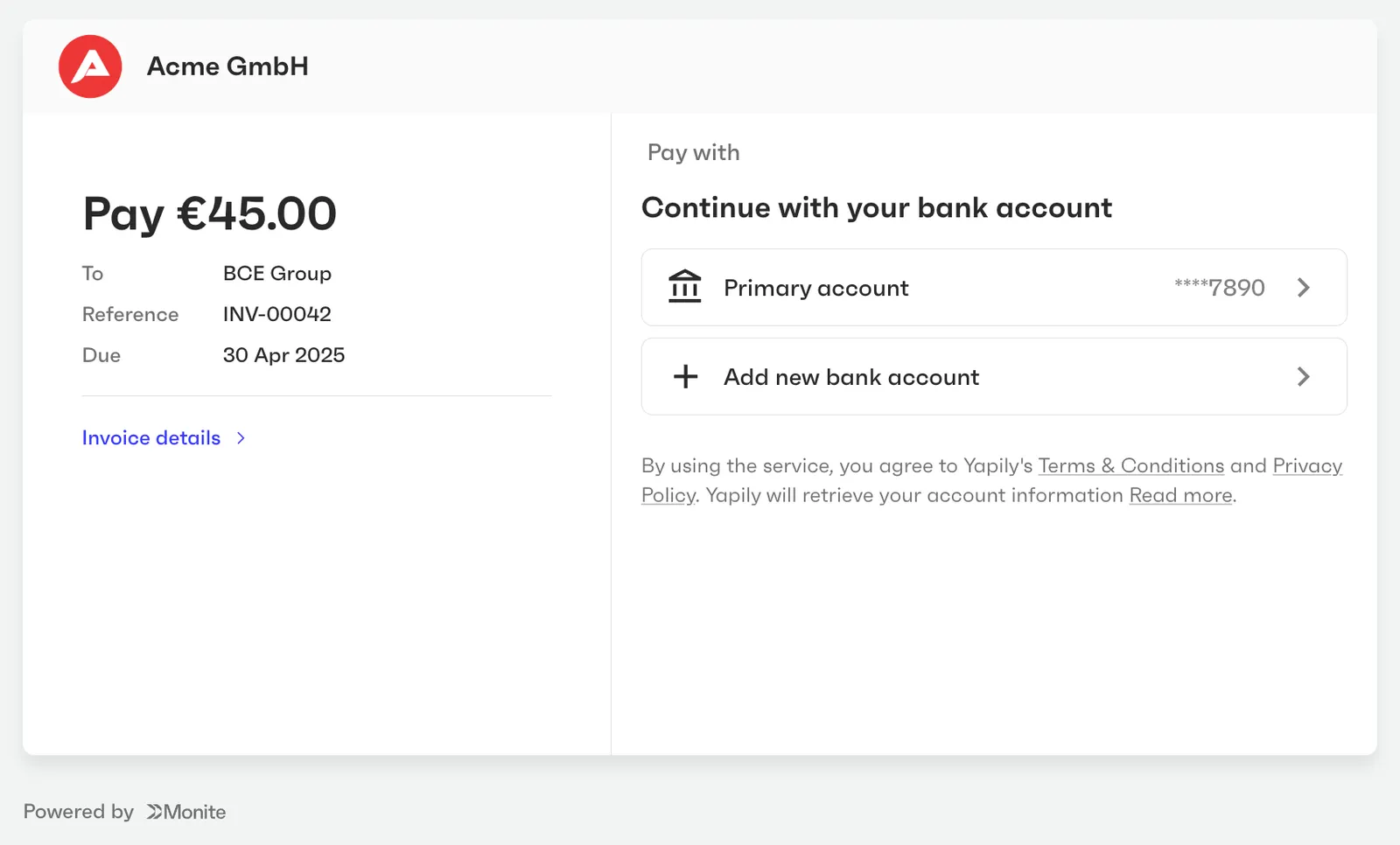
Pre-populating bank accounts during SEPA payments
We’ve improved the payment experience for entities making SEPA Credit payments.
Previously, entity users had to manually select the bank country, bank institution, and enter the account name and IBAN each time they made a payment to a counterpart.
With this update, entity users will be able to:
- View the entity’s existing bank accounts directly in the payment web component or payment page.
- Validate a bank account by selecting the institution and completing a payment. Once validated, the institution won’t need to be selected again for future payments and the IBAN number won’t need to be input.
- See a list of all current validated bank accounts.
- Add a new bank account during payment and choose whether to save it for future use or not.
April 10, 2025
Accounting integration improvements
-
Added support for pushing invoices and credit notes that include discounts:
-
Discounts defined as a fixed amount are recalculated as percentage discounts when pushed into the accounting system.
-
Deductions and incentives are pushed as negative line items with 0% tax rate. If the entity’s accounting system has several 0% tax rates defined, use the entity setting
accounting.to specify which of those 0% tax rate to attach to the deduction line item.tax_ids. deductions
-
-
Fixed an issue where products will very long descriptions could not be pulled from accounting systems.
April 8, 2025
Accounts receivable
We’ve improved the GET /receivables/required_fields endpoint that returns conditionally required invoice fields and counterpart fields to ensure invoice compliance.
This endpoint now supports the counterpart_country and counterpart_type query parameters to check the requirements for a particular country or counterpart type before creating said counterpart.
Usage examples
The two main usage scenarios are now as follows (spaces added for readability):
-
Check whether an organization or individual counterpart from the specified country needs
tax_idand/or VAT ID to be specified on invoices: -
Check whether an existing counterpart needs
tax_idand/or VAT ID to be specified on invoices:
April 7, 2025
Payment record enhancements
We’ve extended the payments records functionality for partners who use external payment rails:
-
Added new fields to payment records:
-
payment_intent_status- user-defined string, can be used to mirror the payment intent status from external payment rails, -
payment_method- user-defined string, for example, “card” or “cash”, -
planned_payment_date- planned date for future scheduled payments, -
status- possible values arecreated,processing, orsucceeded.All payment records created before April 7, 2025 have been assigned thesucceededstatus.
-
-
Added new endpoints to manage the lifecycle of user-created payment records:
PATCH /payment_records/{payment_record_id}- Most editable fields can be updated only while a payment record is in thecreatedstatus, except thepayment_intent_statusfield which can be updated in any payment record status.POST /payment_records/{payment_record_id}/start_processingPOST /payment_records/{payment_record_id}/mark_as_succeededPOST /payment_records/{payment_record_id}/cancel
-
Added new query filters to
GET /payment_recordsto filter results bycreated_at,object_type,paid_at,payment_intent_status,payment_method,planned_payment_date,status, orupdated_at. -
The
paid_atfield was changed from required to optional.
April 3, 2025
Accounts receivable
-
Improvements for VAT-inclusive pricing
-
Flexible discount options. Entities that use VAT-inclusive pricing can choose whether to apply discounts before or after VAT. This is controlled by the entity setting
vat_inclusive_discount_mode. The default mode isexclusive, which means Monite first deducts VAT from a line item’s VAT-inclusive amount and applies the discount to the resulting taxable base. Another mode isinclusive, where discounts are applied to VAT-inclusive amounts.The value of this setting is also returned in the
vat_inclusive_discount_modefield of invoice, quote, and credit note responses to indicate which mode each document uses.Thevat_inclusive_discount_modesetting affects only flat amount discount and does not affect percentage discounts. -
Adjusted the labels in PDFs to indicate when prices and subtotals include or exclude VAT.
-
-
PDF and email improvements
-
Hiding entity bank account from PDFs. We’ve added new entity settings
document_rendering.to control whether PDF invoices, quotes, and credit notes should include entity bank account information. By default, bank account details are included in PDFs but you can change the<document_type>. display_entity_bank_account display_entity_bank_accountsetting tofalseto hide that information.Entity PDF settings
/entities/{entity_id}/settingsHiding bank account details can be useful if the entity uses invoice payment links, this helps ensure that payments can be made only via payment links for automatic reconciliation.
Payment link and QR code are always displayed in PDF invoices, even if bank account details are hidden. -
PDF invoices created by Australian entities registered for GST now use the title “Tax Invoice” instead of “Invoice”.
-
Number formatting in PDFs and emails now uses decimal and thousand separators based on the entity country.
-
-
Longer product descriptions. The maximum length of product descriptions has been increased from 255 to 2000 characters. However, descriptions in PDF documents are currently trimmed down to 255 characters.
-
GET /receivablesnow supports sorting documents bytotal_amount. -
Added new auto-calculated field
subtotal_after_vatto invoice, quote, and credit note responses. It is the sum ofsubtotalandtotal_vat_amount. In other words,subtotal_after_vatcontains the invoice subtotal including VAT and line item discounts but excluding invoice-level discount.
April 2, 2025
Accounts payable
-
Improved filtering by attached file. We’ve added a new query parameter
has_file(trueorfalse) to the endpoints listed below. This allows you to filter documents based on whether they have attachments. -
New AP credit notes fields. We’ve added the new fields
counterpartandcounterpart_rawto the AP credit notes responses for enhanced counterpart data handling.
OCR enhancements
- The
X-Monite-Entity-Idheader is no longer mandatory for all/ocr_tasks*endpoints. - The request body field
document_typeof thePOST /ocr_tasksendpoint is no longer mandatory. Now, if the field is not specified, the system will attempt to determine it automatically. The same applies to thedocument_typequery parameter in the/ocr_tasks/upload_from_fileendpoint.
March 26, 2025
OCR enhancements
We’ve updated the Monite OCR engine to support larger files:
- File size limit has been increased from 10 to 20 MB.
- Maximum number of pages allowed in multipage PDF files has been increased from 10 to 100.
Payments
- Extended the default expiration time for payment links. Payment links created for payables and receivables will now expire 30 days after the invoice due date, unless specified otherwise. This change affects only newly created payment links.
March 25, 2025
Accounts receivable
-
The
issue_dateanddue_dateof issued invoices can now be updated in the non-compliant mode. -
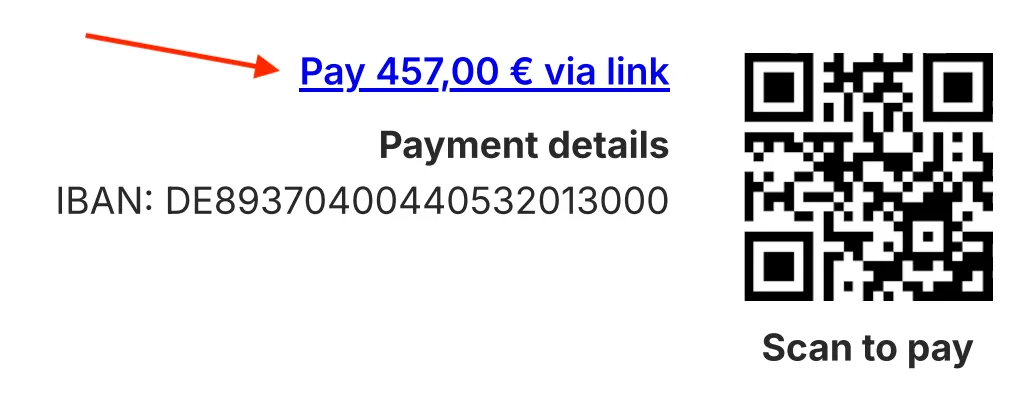
PDF invoices with payment links now include the payment link as text (in addition to a QR code). This way, desktop users can easy access payment links from PDF invoices.
View image
E-invoicing improvements
- Added support for sending e-invoices with discounts - both invoice-level discounts and line item discounts.
Payments
- When a payment link expires, the associated payment intent is now automatically moved to the
payment_cancelledstatus. GET /payment_intentshas a new query parameterobject_id__into bulk get payment intents associated with any of the specified invoices.
March 13, 2025
Accounts receivable
-
Improved PDF file naming. Previously, PDF invoices, quotes, and credit notes used UUIDs as file names, such as
3038dd44-9cce-464d-9e14-58f2fd121850.png. Now, Monite generates PDF file names in the formatTYPE-DOCUMENTID.pdf, for example,Invoice-INV-12345.pdforQuote-draft.pdf. Spaces and special characters are replaced with-.These file names are used for email attachments and when downloading PDFs from React SDK and Drop-in components.
-
Added a new auto-calculated field
total_after_vatto line items in invoices, quotes, and credit notes. It contains the line item amount including discounts and VAT.
March 12, 2025
General
- Deleting user roles. Use the new
DELETE /roles/{role_id}endpoint to delete user roles that are no longer in use.
Accounts payable
-
Support for projects in purchase orders. Purchase orders can now be assigned to projects via the
project_idfield. Also,GET /payable_purchase_ordershas theproject_idquery filter to find all purchase orders that belong to a specific project. -
Improved sorting and filtering of payables and credit notes.
-
Payables can now be sorted by the
issued_atfield. -
Added the
issued_at,issued_at__gt,issued_at__gte,issued_at__lt, andissued_at__ltequery parameters to:GET /payablesGET /analytics/payables
-
Use the
originquery parameter to find only documents received via e-invoicing, or via email, or uploaded directly to Monite. This parameter was added to:GET /payablesGET /payables_credit_notesGET /analytics/payablesGET /analytics/credit_notes
-
-
Unit price OCR adjustments. If a line item’s unit price extracted by OCR has more decimal points than can be precisely stored in Monite, that line item gets normalized as follows:
- set the
unit_priceequal to the line item total amount, - set the
quantityto 1.
For example, an item with unit price € 0.1225 and quantity 8 is instead stored with unit price € 0.98 (0.1225 × 8) and quantity 1.
This ensures precise calculation of subtotal and total amounts.
Line items adjusted in this way have the
ocr_set_quality_to_onefield set totrue. - set the
March 10, 2025
Accounts receivable
-
Added new webhooks for quotes:
receivable.accepted,receivable.declined,receivable.expired. These webhooks are triggered when a quote is moved to the corresponding status. -
Increased the maximum pagination limit for
GET /receivablesfrom 100 to 250 items. The default limit is still 100. -
Improved the performance of the
GET /receivablesendpoint.
Accounting integration improvements
- The response from
GET /accounting_connections/{connection_id}includes a new field,business_info, that contains entity information retrieved from the connected accounting system. Xero application developers can use this information to meet the Xero certification requirement of displaying the name of the connected tenant.
PDF template improvements
-
The
previewfield of PDF templates now contains a link to a PNG preview image of the corresponding template. (Previously, thepreviewfield returnednull.)Example
Response from GET /document_templates/{document_template_id}Previously:
March 3, 2025
Accounting integration improvements
- Improved tax rate matching. Invoice line items have a new field
accounting_tax_rate_id. It allows users to reference a specific tax rate from the accounting system to be used when pushing an invoice to that accounting system. This can be useful if the accounting system contains several tax rates with the same value but only one of them is valid for a given Monite-generated invoice.
Accounts receivable
-
Improved filtering by projects.
GET /receivablesandGET /analytics/receivableshave a new query parameterproject_id__into find all receivables that belong to one or more of the specified projects. -
Fixed an issue with
PATCH /overdue_reminders/{overdue_reminder_id}where passingterms=nulldid not unset the terms.
February 28, 2025
Payments
- Payables (bills) paid via Monite will now be automatically moved from the
paidstatus back topartially_paidorwaiting_to_be_paidif the payment gets disputed or payout to the counterpart fails. - Payment links now support the decoupled authentication flow for Open Banking payments.
- Payment records now support negative
amountvalues to indicate chargebacks and refunds.
February 27, 2025
OCR
- Receipt data recognition. Monite OCR can now extract text and financial data from digital and scanned receipts. Use the
receiptdocument type when uploading receipts for OCR.
Accounts payable
-
Skipping the approval flow. Entities have a new setting
payables_skip_approval_flow. If it istrue, any newly created payables of that entity will be automatically moved from thenewtowaiting_to_be_paidstatus, bypassing approval policies. -
Improved filtering by projects. We’ve added new query parameters
project_idandproject_id__into the endpoints listed below. You can use these parameters to retrieve documents from one or more projects.
February 26, 2025
- Filtering entities by status. Use the new
statusparameter ofGET /entitiesto find only active or inactive entities. - Monite OCR now sends the
ocr_task.finishedwebhook when it finishes processing a file. - For Open Banking payments, Monite now normalizes the payment reference value passed to the payment processing provider to make it compatible with common bank requirements.
February 24, 2025
Credit note improvements (accounts payable)
Now, you can customize the required fields for credit notes. You can now control which fields must be filled in a draft credit note before it can transition to the new status. The following endpoints were added for this purpose:
GET /payable_credit_notes/validations- get the list of required fields.PUT /payable_credit_notes/validations- update the list of required fields.POST /payable_credit_notes/validations/reset- restore the default list of required fields.POST /payable_credit_notes/{credit_note_id}/validate- returns the information that is missing to move a credit note fromdraftto thenewstate.
February 21, 2025
New supported currencies
We’ve updated the list of supported currency codes:
- Added BMD, BTN, FKP, GHS, IQD, LYD, SHP, SSP, SVC, TMT.
- Replaced SLL (old leone) with SLE (new leone).
- Removed HRK (as it was replaced by the euro in 2023).
Accounts receivable
- Added new endpoint
GET /receivables/required_fieldsto get conditionally required invoice fields for the given entity and counterpart. - Added new auto-calculated field
total_vat_amounts[].taxable_amountto invoice, quote, and credit note responses. It contains the taxable amount for which the given VAT is calculated.
Analytics improvements
- Added the
limitquery parameter toGET /analytics/payablesandGET /analytics/credit_notesto control the number of results returned.
Purchase order improvements
- PDF purchase orders now display the entity VAT ID if available.
February 19, 2025
Accounting integration improvements
- Added support for pushing invoices to QuickBooks Online US accounts that use automated sales tax.
February 11, 2025
Monite OCR
- Monite’s OCR now provides generic standalone endpoints for extracting text data from different types of documents across multiple formats, including PDF, JPG, and PNG.
February 3, 2025
Accounts receivable analytics
- Monite analytics has been expanded to include accounts receivable. Use the
GET /analytics/receivablesendpoint as a data source for accounts receivable reports and charts to help entities monitor trends, track KPIs, and gain data-driven insights to optimize their cash flow.
Accounting integration improvements
- Default general ledger account for products. Entities have a new setting
accounting.. It specifies the ledger account to use when pushing products that do not have a ledger account assigned. For more information, see How data is synchronized.ledger_account_ids. products
January 31, 2025
Credit note improvements (accounts payable)
You can configure Monite to automatically link credit notes which have a payable reference to the appropriate payable during the credit note creation. Learn more.
January 29, 2025
Open Banking for Germany
We’ve expanded our payment coverage to include Open Banking payments in Germany. Payment links created for German payers can now include a bank transfer payment option.
This also expands the available payment options for accounts payable and accounts receivable:
- German entities can use payment links to pay payables (bills).
- EU and UK entities can receive invoice payments from their German counterparts via bank transfers.
January 24, 2025
Accounts receivable
-
New webhooks for invoices:
receivable.overdueandreceivable.uncollectible. These webhooks are triggered when an invoice is moved to the corresponding statuses. -
Line item totals in PDF invoices, quotes, and credit notes are now displayed with up to four decimal places. This improvement aligns with a similar change made earlier to line item unit prices in PDFs.
January 22, 2025
Credit note improvements (accounts payable)
- Credit notes analytics. Use the new
GET /analytics/credit_notesendpoint to get real-time insights for credit notes with aggregated data and detailed breakdowns, filters, and metrics. Learn more. - Added the new partner setting
payable.allow_credit_note_autolinkingto allow credit notes to be automatically linked to their related payables. - The
based_onfield is no longer required when creating credit notes.
January 20, 2025
Credit note improvements (accounts payable)
- Two new endpoints added:
POST /payable_credit_notes/upload_from_fileallows you to upload a credit note in the PDF, PNG, or JPG format to Monite. Learn more.POST /payable_credit_notes/{credit_note_id}/cancel_ocrallows you to cancel the OCR scanning process for a specific credit note.
- New fields
file_idandfile_urladded to the credit note responses. - The
based_onfield was changed from required to optional.
January 16, 2025
Accounts receivable
-
Recurring invoice tweaks. The
subject_textandbody_textfields in recurring invoice configuration were changed from required to optional. Recurring invoices will be sent automatically only if bothsubject_textandbody_textare provided, plus eitherrecipientsin the recurrence configuration orcounterpart_contact.emailin the base invoice. -
PDF improvements. Unit prices in PDF invoices, quotes, and credit notes are now displayed with up to four decimal places. This allows for more precise display of prices in documents that use VAT-inclusive pricing.
December 23, 2024
Accounts receivable
- Improved filtering by tags. New
tag_idsquery parameter inGET /receivableslets you find receivables that have all of the specified tags. In other words, this filter works as an AND and is an alternative to the existingtag_ids__infilter that works as an OR.
December 19, 2024
E-invoicing
- Monite now integrates provides a global e-invoicing solution to help our partners to create and send e-invoices using the Monite API. This integration enables Monite clients to stay compliant in the regions where E-invoicing becomes mandatory. See more.
December 16, 2024
API version 2024-05-25 is now publicly available to all Monite partners. To start using this version:
-
Change the
api_versionsetting in your partner settings (/settings) to2024-05-25: -
Change the
X-Monite-Versionheader value in all API calls to2024-05-25. For example:
For more information, see How to upgrade.