

Monite API changelog
April 11, 2025
Pre-populating bank accounts during SEPA payments
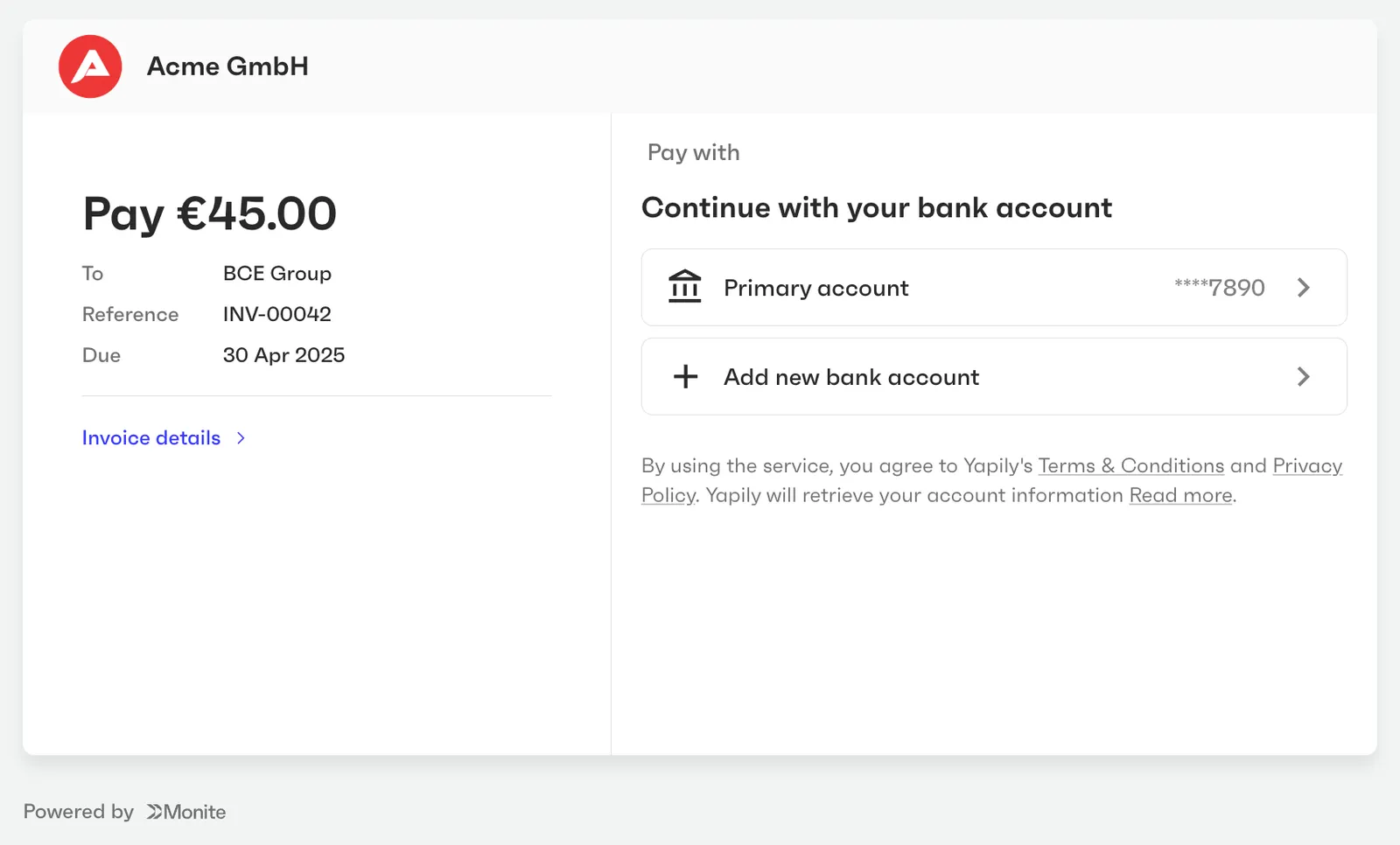
We’ve improved the payment experience for entities making SEPA Credit payments.
Previously, entity users had to manually select the bank country, bank institution, and enter the account name and IBAN each time they made a payment to a counterpart.
With this update, entity users will be able to:
- View the entity’s existing bank accounts directly in the payment web component or payment page.
- Validate a bank account by selecting the institution and completing a payment. Once validated, the institution won’t need to be selected again for future payments and the IBAN number won’t need to be input.
- See a list of all current validated bank accounts.
- Add a new bank account during payment and choose whether to save it for future use or not.
April 10, 2025
Accounting integration improvements
-
Added support for pushing invoices and credit notes that include discounts:
-
Discounts defined as a fixed amount are recalculated as percentage discounts when pushed into the accounting system.
-
Deductions and incentives are pushed as negative line items with 0% tax rate. If the entity’s accounting system has several 0% tax rates defined, use the entity setting
accounting.to specify which of those 0% tax rate to attach to the deduction line item.tax_ids. deductions
-
-
Fixed an issue where products will very long descriptions could not be pulled from accounting systems.
April 8, 2025
Accounts receivable
We’ve improved the GET /receivables/required_fields endpoint that returns conditionally required invoice fields and counterpart fields to ensure invoice compliance.
This endpoint now supports the counterpart_country and counterpart_type query parameters to check the requirements for a particular country or counterpart type before creating said counterpart.
Usage examples
The two main usage scenarios are now as follows (spaces added for readability):
-
Check whether an organization or individual counterpart from the specified country needs
tax_idand/or VAT ID to be specified on invoices: -
Check whether an existing counterpart needs
tax_idand/or VAT ID to be specified on invoices:
April 7, 2025
Payment record enhancements
We’ve extended the payments records functionality for partners who use external payment rails:
-
Added new fields to payment records:
-
payment_intent_status- user-defined string, can be used to mirror the payment intent status from external payment rails, -
payment_method- user-defined string, for example, “card” or “cash”, -
planned_payment_date- planned date for future scheduled payments, -
status- possible values arecreated,processing, orsucceeded.All payment records created before April 7, 2025 have been assigned thesucceededstatus.
-
-
Added new endpoints to manage the lifecycle of user-created payment records:
PATCH /payment_records/{payment_record_id}- Most editable fields can be updated only while a payment record is in thecreatedstatus, except thepayment_intent_statusfield which can be updated in any payment record status.POST /payment_records/{payment_record_id}/start_processingPOST /payment_records/{payment_record_id}/mark_as_succeededPOST /payment_records/{payment_record_id}/cancel
-
Added new query filters to
GET /payment_recordsto filter results bycreated_at,object_type,paid_at,payment_intent_status,payment_method,planned_payment_date,status, orupdated_at. -
The
paid_atfield was changed from required to optional.
April 3, 2025
Accounts receivable
-
Improvements for VAT-inclusive pricing
-
Flexible discount options. Entities that use VAT-inclusive pricing can choose whether to apply discounts before or after VAT. This is controlled by the entity setting
vat_inclusive_discount_mode. The default mode isexclusive, which means Monite first deducts VAT from a line item’s VAT-inclusive amount and applies the discount to the resulting taxable base. Another mode isinclusive, where discounts are applied to VAT-inclusive amounts.The value of this setting is also returned in the
vat_inclusive_discount_modefield of invoice, quote, and credit note responses to indicate which mode each document uses.Thevat_inclusive_discount_modesetting affects only flat amount discount and does not affect percentage discounts. -
Adjusted the labels in PDFs to indicate when prices and subtotals include or exclude VAT.
-
-
PDF and email improvements
-
Hiding entity bank account from PDFs. We’ve added new entity settings
document_rendering.to control whether PDF invoices, quotes, and credit notes should include entity bank account information. By default, bank account details are included in PDFs but you can change the<document_type>. display_entity_bank_account display_entity_bank_accountsetting tofalseto hide that information.Entity PDF settings
/entities/{entity_id}/settingsHiding bank account details can be useful if the entity uses invoice payment links, this helps ensure that payments can be made only via payment links for automatic reconciliation.
Payment link and QR code are always displayed in PDF invoices, even if bank account details are hidden. -
PDF invoices created by Australian entities registered for GST now use the title “Tax Invoice” instead of “Invoice”.
-
Number formatting in PDFs and emails now uses decimal and thousand separators based on the entity country.
-
-
Longer product descriptions. The maximum length of product descriptions has been increased from 255 to 2000 characters. However, descriptions in PDF documents are currently trimmed down to 255 characters.
-
GET /receivablesnow supports sorting documents bytotal_amount. -
Added new auto-calculated field
subtotal_after_vatto invoice, quote, and credit note responses. It is the sum ofsubtotalandtotal_vat_amount. In other words,subtotal_after_vatcontains the invoice subtotal including VAT and line item discounts but excluding invoice-level discount.
April 2, 2025
Accounts payable
-
Improved filtering by attached file. We’ve added a new query parameter
has_file(trueorfalse) to the endpoints listed below. This allows you to filter documents based on whether they have attachments. -
New AP credit notes fields. We’ve added the new fields
counterpartandcounterpart_rawto the AP credit notes responses for enhanced counterpart data handling.
OCR enhancements
- The
X-Monite-Entity-Idheader is no longer mandatory for all/ocr_tasks*endpoints. - The request body field
document_typeof thePOST /ocr_tasksendpoint is no longer mandatory. Now, if the field is not specified, the system will attempt to determine it automatically. The same applies to thedocument_typequery parameter in the/ocr_tasks/upload_from_fileendpoint.
March 26, 2025
OCR enhancements
We’ve updated the Monite OCR engine to support larger files:
- File size limit has been increased from 10 to 20 MB.
- Maximum number of pages allowed in multipage PDF files has been increased from 10 to 100.
Payments
- Extended the default expiration time for payment links. Payment links created for payables and receivables will now expire 30 days after the invoice due date, unless specified otherwise. This change affects only newly created payment links.
March 25, 2025
Accounts receivable
-
The
issue_dateanddue_dateof issued invoices can now be updated in the non-compliant mode. -
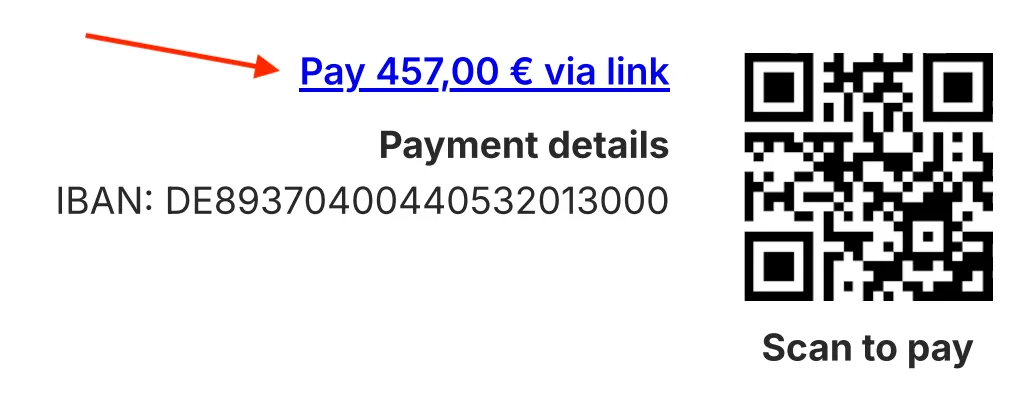
PDF invoices with payment links now include the payment link as text (in addition to a QR code). This way, desktop users can easy access payment links from PDF invoices.
View image
E-invoicing improvements
- Added support for sending e-invoices with discounts - both invoice-level discounts and line item discounts.
Payments
- When a payment link expires, the associated payment intent is now automatically moved to the
payment_cancelledstatus. GET /payment_intentshas a new query parameterobject_id__into bulk get payment intents associated with any of the specified invoices.
March 13, 2025
Accounts receivable
-
Improved PDF file naming. Previously, PDF invoices, quotes, and credit notes used UUIDs as file names, such as
3038dd44-9cce-464d-9e14-58f2fd121850.png. Now, Monite generates PDF file names in the formatTYPE-DOCUMENTID.pdf, for example,Invoice-INV-12345.pdforQuote-draft.pdf. Spaces and special characters are replaced with-.These file names are used for email attachments and when downloading PDFs from React SDK and Drop-in components.
-
Added a new auto-calculated field
total_after_vatto line items in invoices, quotes, and credit notes. It contains the line item amount including discounts and VAT.
March 12, 2025
General
- Deleting user roles. Use the new
DELETE /roles/{role_id}endpoint to delete user roles that are no longer in use.
Accounts payable
-
Support for projects in purchase orders. Purchase orders can now be assigned to projects via the
project_idfield. Also,GET /payable_purchase_ordershas theproject_idquery filter to find all purchase orders that belong to a specific project. -
Improved sorting and filtering of payables and credit notes.
-
Payables can now be sorted by the
issued_atfield. -
Added the
issued_at,issued_at__gt,issued_at__gte,issued_at__lt, andissued_at__ltequery parameters to:GET /payablesGET /analytics/payables
-
Use the
originquery parameter to find only documents received via e-invoicing, or via email, or uploaded directly to Monite. This parameter was added to:GET /payablesGET /payables_credit_notesGET /analytics/payablesGET /analytics/credit_notes
-
-
Unit price OCR adjustments. If a line item’s unit price extracted by OCR has more decimal points than can be precisely stored in Monite, that line item gets normalized as follows:
- set the
unit_priceequal to the line item total amount, - set the
quantityto 1.
For example, an item with unit price € 0.1225 and quantity 8 is instead stored with unit price € 0.98 (0.1225 × 8) and quantity 1.
This ensures precise calculation of subtotal and total amounts.
Line items adjusted in this way have the
ocr_set_quality_to_onefield set totrue. - set the
March 10, 2025
Accounts receivable
-
Added new webhooks for quotes:
receivable.accepted,receivable.declined,receivable.expired. These webhooks are triggered when a quote is moved to the corresponding status. -
Increased the maximum pagination limit for
GET /receivablesfrom 100 to 250 items. The default limit is still 100. -
Improved the performance of the
GET /receivablesendpoint.
Accounting integration improvements
- The response from
GET /accounting_connections/{connection_id}includes a new field,business_info, that contains entity information retrieved from the connected accounting system. Xero application developers can use this information to meet the Xero certification requirement of displaying the name of the connected tenant.
PDF template improvements
-
The
previewfield of PDF templates now contains a link to a PNG preview image of the corresponding template. (Previously, thepreviewfield returnednull.)Example
Response from GET /document_templates/{document_template_id}Previously:
March 3, 2025
Accounting integration improvements
- Improved tax rate matching. Invoice line items have a new field
accounting_tax_rate_id. It allows users to reference a specific tax rate from the accounting system to be used when pushing an invoice to that accounting system. This can be useful if the accounting system contains several tax rates with the same value but only one of them is valid for a given Monite-generated invoice.
Accounts receivable
-
Improved filtering by projects.
GET /receivablesandGET /analytics/receivableshave a new query parameterproject_id__into find all receivables that belong to one or more of the specified projects. -
Fixed an issue with
PATCH /overdue_reminders/{overdue_reminder_id}where passingterms=nulldid not unset the terms.
February 28, 2025
Payments
- Payables (bills) paid via Monite will now be automatically moved from the
paidstatus back topartially_paidorwaiting_to_be_paidif the payment gets disputed or payout to the counterpart fails. - Payment links now support the decoupled authentication flow for Open Banking payments.
- Payment records now support negative
amountvalues to indicate chargebacks and refunds.
February 27, 2025
OCR
- Receipt data recognition. Monite OCR can now extract text and financial data from digital and scanned receipts. Use the
receiptdocument type when uploading receipts for OCR.
Accounts payable
-
Skipping the approval flow. Entities have a new setting
payables_skip_approval_flow. If it istrue, any newly created payables of that entity will be automatically moved from thenewtowaiting_to_be_paidstatus, bypassing approval policies. -
Improved filtering by projects. We’ve added new query parameters
project_idandproject_id__into the endpoints listed below. You can use these parameters to retrieve documents from one or more projects.
February 26, 2025
- Filtering entities by status. Use the new
statusparameter ofGET /entitiesto find only active or inactive entities. - Monite OCR now sends the
ocr_task.finishedwebhook when it finishes processing a file. - For Open Banking payments, Monite now normalizes the payment reference value passed to the payment processing provider to make it compatible with common bank requirements.
February 24, 2025
Credit note improvements (accounts payable)
Now, you can customize the required fields for credit notes. You can now control which fields must be filled in a draft credit note before it can transition to the new status. The following endpoints were added for this purpose:
GET /payable_credit_notes/validations- get the list of required fields.PUT /payable_credit_notes/validations- update the list of required fields.POST /payable_credit_notes/validations/reset- restore the default list of required fields.POST /payable_credit_notes/{credit_note_id}/validate- returns the information that is missing to move a credit note fromdraftto thenewstate.
February 21, 2025
New supported currencies
We’ve updated the list of supported currency codes:
- Added BMD, BTN, FKP, GHS, IQD, LYD, SHP, SSP, SVC, TMT.
- Replaced SLL (old leone) with SLE (new leone).
- Removed HRK (as it was replaced by the euro in 2023).
Accounts receivable
- Added new endpoint
GET /receivables/required_fieldsto get conditionally required invoice fields for the given entity and counterpart. - Added new auto-calculated field
total_vat_amounts[].taxable_amountto invoice, quote, and credit note responses. It contains the taxable amount for which the given VAT is calculated.
Analytics improvements
- Added the
limitquery parameter toGET /analytics/payablesandGET /analytics/credit_notesto control the number of results returned.
Purchase order improvements
- PDF purchase orders now display the entity VAT ID if available.
February 19, 2025
Accounting integration improvements
- Added support for pushing invoices to QuickBooks Online US accounts that use automated sales tax.
February 11, 2025
Monite OCR
- Monite’s OCR now provides generic standalone endpoints for extracting text data from different types of documents across multiple formats, including PDF, JPG, and PNG.
February 3, 2025
Accounts receivable analytcs
- Monite analytics has been expanded to include accounts receivable. Use the
GET /analytics/receivablesendpoint as a data source for accounts receivable reports and charts to help entities monitor trends, track KPIs, and gain data-driven insights to optimize their cash flow.
Accounting integration improvements
- Default general ledger account for products. Entities have a new setting
accounting.. It specifies the ledger account to use when pushing products that do not have a ledger account assigned. For more information, see How data is synchronized.ledger_account_ids. products
January 29, 2025
Open Banking for Germany
We’ve expanded our payment coverage to include Open Banking payments in Germany. Payment links created for German payers can now include a bank transfer payment option.
This also expands the available payment options for accounts payable and accounts receivable:
- German entities can use payment links to pay payables (bills).
- EU and UK entities can receive invoice payments from their German counterparts via bank transfers.
January 24, 2025
Accounts receivable
-
New webhooks for invoices:
receivable.overdueandreceivable.uncollectible. These webhooks are triggered when an invoice is moved to the corresponding statuses. -
Line item totals in PDF invoices, quotes, and credit notes are now displayed with up to four decimal places. This improvement aligns with a similar change made earlier to line item unit prices in PDFs.
January 22, 2025
Credit note improvements (accounts payable)
- Credit notes analytics. Use the new
GET /analytics/credit_notesendpoint to get real-time insights for credit notes with aggregated data and detailed breakdowns, filters, and metrics. Learn more. - The
based_onfield is no longer required when creating credit notes.
January 20, 2025
Credit note improvements (accounts payable)
- Two new endpoints added:
POST /payable_credit_notes/upload_from_fileallows you to upload a credit note in the PDF, PNG, or JPG format to Monite. Learn more.POST /payable_credit_notes/{credit_note_id}/cancel_ocrallows you to cancel the OCR scanning process for a specific credit note.
- New fields
file_idandfile_urladded to the credit note responses. - The
based_onfield was changed from required to optional.
January 16, 2025
Accounts receivable
- PDF improvements. Unit prices in PDF invoices, quotes, and credit notes are now displayed with up to four decimal places. This allows for more precise display of prices in documents that use VAT-inclusive pricing.
December 23, 2024
Accounts Receivable
- Improved filtering by tags. New
tag_idsquery parameter inGET /receivableslets you find receivables that have all of the specified tags. In other words, this filter works as an AND and is an alternative to the existingtag_ids__infilter that works as an OR.
December 13, 2024
Accounts Payable
Credit notes and MoniteScript. We added support for the new connector types and methods in MoniteScript:
CreditNote.approveCreditNote.rejectCreditNote.add_tags
December 9, 2024
Accounting integration improvements
- Payment records are now pushed into accounting systems. Entities can specify the ledger account for payment records by using the entity setting
accounting.. For more information, see How data is synchronized.ledger_account_ids. payments
December 5, 2024
- Entity name limit has been increased from 100 to 255 characters. An exception are entities that use payments - their names are still capped at 100 characters due to restrictions of payment processing platforms.
December 4, 2024
Accounts receivable
-
Webhooks for receivables. You can now receive webhooks when invoices (including recurring invoices), quotes, and credit notes are created or updated in your entities’ accounts. For a list of available webhooks, see Webhooks.
-
Document history improvements:
- The
receivable_updatedevent is now also generated for line item updates. - Added new events:
receivable_created,payment_reminder_mail_sent,overdue_reminder_mail_sent.
These events are available starting from December 4, 2024 and are not filled retroactively. - The
-
Optimized the
GET /vat_ratesendpoint to reduce the response time.
Role-based access control (RBAC)
- RBAC for mailboxes.
GET /mailboxes,POST /mailboxes, andDELETE /mailboxes/{mailbox_id}endpoints can now be called with entity user access tokens. Users need a role with themailboxpermission to access these endpoints.
December 2, 2024
Payment link improvements
- Payment links can now also be created for partially paid payables.
return_urlis now optional for all payment links. Previously it was required when creating payment links for payables.
November 28, 2024
Accounts Payable
-
Credit notes for AP. Now, credit notes can be used to reduce the amount owed on a payable after it was issued.
-
New fields also added to the
payablesresponses:credit_notes- a list of credit notes associated with the payable.total_amount_with_credit_notesthe total amount of the payable with credit notes applied.
-
New analytics endpoints. The new endpoint
GET /analytics/payablesallows you to get real-time aggregated data with detailed breakdowns, filters, and metrics. See more.- The endpoint
GET /payables/analyticshas been deprecated.
- The endpoint
November 22, 2024
Accounting integration improvements
- Credit notes are now pushed into accounting systems. For more information, see How data is synchronized.
October 31, 2024
General
Simplified bank account setup for African entities:
- African entities can now add bank accounts with any currency.
- Apart from
currencyandcountry, their bank accounts can include any other data fields or combinations thereof.
Accounts Payable
-
Discounts in payables. Use the
discountfield to specify a flat discount amount for a payable. -
New
process_idquery parameter inGET /approval_policieslets you find a policy that triggered a specific approval process. -
New webhooks related to approval policies:
approval_policy_process.created- triggered when an approval policy is initiated for a payable,approval_policy_process.execution_error- triggered when an error occurs during the execution of an approval policy,payable.multiple_approval_policies_matched- triggered when a payable matches more than one approval policy. Neither policy will be executed.
October 29, 2024
Accounts Receivable
- Support for user-defined document numbers. In the non-compliant mode, entities can now directly specify document numbers (such as
INV/2024/017) for created invoices, quotes, and credit notes instead of using auto-generated document numbers. This can be useful if the entity needs the the numbering format that is not covered by Monite’s built-in customization options.
October 23, 2024
Payments
New fields in payment intent objects:
payer.namepayer.bank_accounts[].routing_numberrecipient.bank_accounts[].routing_number
October 21, 2024
Accounts Payable
- Payable improvement:
- The
GET /payables/validationsendpoint can now be accessed with entity user tokens.
- The
- Approval policy improvements:
- Now you can define optional start and end dates for approval policies to accommodate seasonal changes, holidays, temporary changes in the organizational structure, and so on.
- New connector
Currencywas added to thetriggerparameter in MoniteScript. This connector is used to convert the amount of a payable based on a currency exchange rate. This allows you to create trigger conditions for payable amounts with different currencies.
Accounts Receivable
- Line items of
issuedandoverdueinvoices can be updated if an entity uses the non-compliant mode.
October 4, 2024
Accounts Payable
-
Payable improvements:
-
Deleting payables. Payables in any status can now be deleted by using the new
DELETE /payables/{payable_id}endpoint. Entity users need thepayable.deletepermission to be able to delete payables. Successful deletion of a payable triggers thepayable.deletedwebhook. -
Improved search. We’ve improved search and filter parameters in
GET /payablesandGET /payables/analytics:- New
search_textparameter lets you perform partial, case-insensitive search across multiple text fields of a payable at the same time. Currently it searches in counterpart names and document numbers (document_id). - Added the
counterpart_name__containsandcounterpart_name__icontainsfor searching by partial counterpart name in the case-sensitive and case-insensitive modes, respectively.
- New
-
Payables have a new read-only field
created_by_role_idthat indicates the role of the entity user who created this payable. -
Projects and tags can now be updated for payables in any status.
-
-
Purchase order improvements:
- The
entity_vat_id_idfield is now optional in purchase orders and can also be unset (that is, changed tonull). - Updated PDF templates for purchase orders. Added the “Supplier” block and updated some labels for improved clarity.
- The
-
Approval policy improvement:
- Projects can now be used in approval policy conditions. For this, the
invoice.project_idattribute must be added to thetriggerobject. See an example.
- Projects can now be used in approval policy conditions. For this, the
Accounting integration improvements
We’ve added new endpoints to list invoices and payables (bills) that exist in the entity’s connected accounting system without pulling those documents into Monite. Monite partners can use these endpoints to implement custom document comparison and synchronization logic.
GET /accounting/receivablesGET /accounting/receivables/{invoice_id}GET /accounting/payablesGET /accounting/payables/{payable_id}
September 30, 2024
Accounts receivable document history
Monite now keeps a record of all changes made to each invoice, quote, and credit notes, from document creation to the final status. This provides entities with an overview of how a document has evolved over time. For example, entity users can see the following:
- all revisions made to an individual invoice, quote, or credit note before it was sent to the client,
- who made a change and when,
- when a particular status transition occurred (for example, when a quote was signed),
- payments made towards an invoice,
- emails sent to the clients and the recipient email addresses,
- and more.
To access a document’s history, use the following endpoints:
For more information, see Document history.
September 4, 2024
General
- Projects. Users can now aggregate and track payables and receivables under the same work scope as a project via the new
/projectsendpoints. See more.- New
create,read,update, anddeletepermissions for theprojectobject. - New webhooks for the
created,deleted, andupdatedevents of projects. - Payables and receivables can be filtered by project via the new
project_idquery parameter in theGET /payablesandGET /receivablesendpoints.
- New
Accounts Payable
- Payable analytics. Use the new
GET /payables/analyticsendpoint to get the total number and sum total amount of all existing payables, along with the breakdown per payable status. Results can be narrowed down to a specific time period, counterpart, or other search filters. See more. - Find and filter payables by tags. The
GET /payablesendpoint has a new query parametertag_idsto find payables that have any of the specified tags.
Accounts Receivable
We’ve added a few improvements to paid invoices:
- Paid invoices can now be sent via email.
- Added a new entity setting
generate_paid_invoice_pdf. If it is set to true, the PDF version of paid invoices will indicate that the invoice is already paid. The PDF file gets regenerated at the moment when an invoice becomes paid. It is not issued as a separate document and the original PDF invoice is no longer available. - Added a new email template
receivables_paid_invoicethat is used when sending paid invoices. It is similar to thereceivables_invoicetemplate used for unpaid invoices but does not include the Pay invoice link.
Other
- Added the
last_updated_atfield to the responses from the/mailbox_domainsendpoints.
August 29, 2024
General
- Deleting entity users. New endpoint
DELETE /entity_users/{entity_user_id}allows you to delete an entity user.
August 23, 2024
Accounts Receivable
-
Tags for receivables. Invoices, quotes, and credit notes can now have tags (labels) assigned to them. You can also find and filter these documents by tags by using the
tag_ids__inquery parameter of theGET /receivablesendpoint. -
Invoice payment date. Invoice responses include the new
paid_atfield that indicates the date and time when the invoice was fully paid. When using accounts receivable together with Monite payment rails, thepaid_attimestamp is filled in automatically when counterparts pay invoices. If you use external payment rails, thepaid_attimestamp is taken from the corresponding field provided in thePOST /payment_recordsorPOST /receivables/{invoice_id}/mark_as_paidrequest.- Added a new optional request field
paid_attoPOST /receivables/{invoice_id}/mark_as_paid. If omitted, it defaults to the date and time of the request.
- Added a new optional request field
-
Previously, recurring invoice schedules could only be extended. Now they can also be shortened - as long as the new end date is still a future date.
August 21, 2024
Accounts Receivable
- New entity setting
vat_modecontrols whether new invoices and quotes use VAT-exclusive pricing (default) or VAT-inclusive pricing. This can be overridden on the document level by providing thevat_modefield when creating invoices and quotes.
August 15, 2024
General
- Tags for counterparts. Counterparts can now have tags (labels) assigned to them. You can also find and filter counterparts by tags by using the
tag_ids__inquery parameter of theGET /counterpartsendpoint.
Accounts Receivable
-
Support for VAT-inclusive prices. Use the
vat_modefield of invoices and quotes to specify whether product prices include or exclude VAT. In case of VAT-inclusive pricing, Monite will calculate the taxable base price by subtracting the VAT rate from the productprice.Line item data in API responses includes both VAT-inclusive and VAT-exclusive prices calculated based on the original product price and the chosen
vat_mode:line_items[].product.price- price before VATline_items[].product.price_after_vat- price with VAT
Note: after an invoice or quote is created, its
vat_modecannot be changed, event in draft documents. -
Multi-branding enhancements. We’ve expanded the ability to change entity branding information (
email,logo,phone, andwebsite) for accounts receivable documents:- Branding information can now be changed not only for invoices, but also for quotes and credit notes.
- Previously, entity branding information could be changed only for existing documents via
PATCH /receivables/{receivable_id}. Now you can also specify this information directly during document creation - by providing theentityobject in thePOST /receivablesrequest.
August 7, 2024
Payments
-
Search and filter payment intents. Use the new
GET /payment_intentsendpoint to get a list of all payment intents created for an entity. Optionally, you can provide theobject_idquery parameter to find intents associated with a specific accounts payable or accounts receivable invoice:GET /payment_intents?object_id=INVOICE_ID.Among other things, this lets you:
- Get the status of an invoice payment (such as
processingorsettled). - Find an existing payment link created for an invoice.
- Get the status of an invoice payment (such as
July 31, 2024
Accounts Receivable
-
Create invoices and quotes with inline products. Entities can now specify the product details for line items—name, price, and other attributes—directly in the request payload without having to create a product catalog in advance. This is useful for one-off invoices or if the entity’s product catalog is maintained outside of the Monite platform. Invoices and quotes can also use a mix of inline and catalog products if needed.
Example
-
Digital quote signing. Entities can now require that their customers (counterparts) provide a signature when accepting quotes. If the quote field
signature_requiredistrue, the counterpart’s representative needs to provide their name, email address, and signature image to accept the quote.Example
After the quote is accepted, its PDF file is updated to display the customer signature.
Entity setting
quote_signature_requiredcontrols the signature requirement for newly created quotes. This can be changed at the quote level via thesignature_requiredfield.
Accounts Payable
- New query parameter
id__ininGET /tagsto bulk fetch multiple tags by their IDs.
July 17, 2024
Accounts Payable
- New endpoint
PUT /payables/{payable_id}/line_itemsthat replaces all line items of a specific payable at once.
Accounts Receivable
- New response fields —
file_languageandoriginal_file_language— in quotes, invoices, and credit notes. These fields indicate the counterpart’s and entity’s language for the PDF, respectively.
Accounting integration
- Removed the
/accounting_sync_rulesendpoints that were used to customize invoice and payable statuses to push to an accounting system. - New endpoints for accounting integration:
- The
/accounting_synced_recordsendpoints to retrieve or push records of synchronizations between Monite’s database and the entity’s accounting system. - The
/accounting_tax_ratesto get tax rate from the accounting system.
- The
July 3, 2024
General
- New supported country codes:
BL- Saint BarthélemyBQ- Caribbean NetherlandsCW- CuraçaoMF- Saint Martin (French part)SX- Sint Maarten (Dutch part)
- Entity field
address.stateis now required for US entities that wish to use Monite payment rails.
Accounts Payable
- Payable OCR auto-tagging. Entities have a new setting
payables_ocr_auto_taggingto specify the tags that will be automatically assigned to new payables created via OCR. For details, see Tags auto-assignment. - New
paid_atfield was added to the payable responses. It contains the date and time when the payable was moved to thepaidstatus.
Accounts Receivable
-
Invoicing across multiple brands. Entities that have multiple brands can specify the business
email,logo,phone, andwebsiteto be displayed on each invoice, if these values need to be different from the entity’s defaults. The data can be provided in theinvoice.entityobject in the invoice update request, for example: -
More flexible reminder configuration. Invoice payment reminders and overdue reminders can now be initially created without any terms, and the terms can be added any time later prior to issuing the invoice.
-
Email localization improvements:
- The
languagefield inPOST /receivables/{receivable_id}/sendrequests has been deprecated. Instead, use the counterpart’slanguagefield to specify the preferred language for emails and documents that will be sent to that counterpart. - Also, if the
languageparameter is omitted in/sendrequests, the email language now defaults to the counterpart language instead of English.
- The
-
Partner metadata can now also be updated for non-
draftinvoices, quotes, and credit notes.
June 19, 2024
- CC and BCC in receivables email. Added the ability to include a list of email addresses using the
recipientsfield in the payload the/receivables/{receivable_id}/sendand/receivables/{receivable_id}/send_test_reminderendpoints. Using this field, entities can include email addresses to which they want to send a copy or a blind copy of the email. - Displaying company trade name in documents. Invoices, quotes, and credit notes have the new
trade_namefield that entities can use to specify their trade name, also known as “doing business as” (DBA) or “operating as” (o/a) name. The assigned trade name will appear alongside the entity’s legal name in PDF invoices, quotes, and credit notes created by the entity. - Enhanced sorting of receivables. The
GET /receivablesendpoint has got additional options for thesortparameter. You can now also sort receivables by thecreated_at,document_id,due_date, orissue_datevalues. - The
measure_unit_idfield is no longer required to create products for receivables. - New
id__inquery parameter on theGET /productsandGET /receivablesendpoints lets you bulk fetch multiple products or receivables by their IDs.
June 5, 2024
- New
name__inquery parameter inGET /tags. - Payable tags have two new optional fields:
categoryanddescription. - Partner setting
payable.enable_line_itemshas been deprecated.
May 22, 2024
- Automatic matching of purchase orders with payables. Every time a payable is created or updated, Monite automatically tries to link this payable to its corresponding purchase order, which is already created in the system. For such cases, the field
purchase_order_idwas added to thepayableobject. To configure this behavior, the fieldallow_purchase_order_autolinking(default value equals totrue) was added to the entity settings. - Added a new
original_file_urlfield in responses for invoices, quotes, and credit notes that returns the receivables PDF in the entity’s language. The field was also added to the response of theGET /receivables/{receivable_id}/pdf_linkendpoint.
May 8, 2024
- Document number customization. We added the ability to customize the document numbers for all document types. This customization is done directly via entity settings. For more information, see Document number customization.
April 11, 2024
- Payment intents can now transition to the
refundedstatus from thepayout_failedandpayout_cancelledstatuses.
April 2, 2024
- Searching payables by invoice number.
GET /payableshas new optional query parameters to search and filter Accounts Payable invoices (payables) by their invoice number:document_id__contains(case-sensitive “contains”),document_id__icontains(case-insensitive “contains”). - Customizing the required fields for payables. You can now control which fields must be filled in a
draftpayable before it can transition to thenewstatus. The following endpoints were added for this purpose:GET /payables/validations- get the list of required fields.PUT /payables/validations- update the list of required fields.POST /payables/validations/reset- restore the default list of required fields.
- Testing reminders for a specific invoice. Use the new endpoint
POST /receivables/{receivable_id}/send_test_reminderto send test email reminders (payment reminders or overdue reminders) for a specific Accounts Receivable invoice. For more information, see Manually trigger payment reminders. - Verifying invoice reminder configuration. The response from
POST /receivables/{receivable_id}/verifycontains the newwarnings.payment_remindersfield that indicates issues with payment reminders configured for the specified invoice. Misconfigured reminders do not block the ability to issue the invoice, but can result in reminders not being sent. Users are advised to fix the reminder configuration issues before issuing invoices. GET /vat_rateshas a new optional query parametercounterpart_address_idto filter the applicable VAT rates based on the specified counterpart address in case the counterpart has several addresses.- Updated the supported country codes:
- Replaced
CS(Serbia and Montenegro) withME(Montenegro) andRS(Serbia). - Added
SS(South Sudan)
- Replaced
March 18, 2024
API version 2024-01-31 is now publicly available to all Monite partners to use in beta. To start using this version:
-
Change the
api_versionsetting in your partner settings (/settings) to2024-01-31: -
Change the
X-Monite-Versionheader value in all API calls to2024-01-31. For example:
For more information, see How to upgrade.